About me
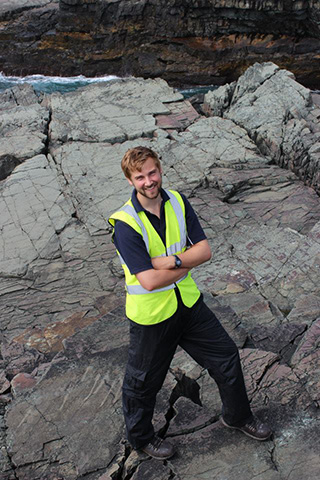
Hi, I'm Dr Thomas Wong Hearing, a trainee maths teacher with Sheffield Teacher Training Alliance. I built this website whilst I was a research scientist and it remains mostly about my academic research and univeristy teaching. I may update this site over the next few months with details about my new teaching work, but for now it will remain focused on my geoscience and adjacent research interests.
My academic research focuses on understanding Earth-biosphere interactions in deep time, and I have recently expanded to look more at current and near-future biosphere change. I use geological data and Earth system models to interrogate Earth's ancient climates and environments, particularly using sediments and fossils, and their chemistry, to understand the physical nature of past worlds. My background since my PhD is primarily as a 'data' person, as opposed to a 'modelling' person, but I do mix-and-match between these two spheres and my current role that involves a lot more modelling work, including designing and running climate model experiments.
My primary research focus is in understanding what happened to Earth's climate and physical environments when early animal-rich ecosystems were first evolving around the transition between the Neoproterozoic and Phanerozoic eons, about 600 to 500 million years ago. We have recently published a rigorously evaluated climate state framework for the late Ediacaran (~600 to 538.8 million years ago). We found that the late Ediacaran experience alternating icehouse (with polar ice sheets) and greenhouse (without polar ice sheets) climate states, and that the changes between these climate states were likely coupled with changes in the Ediacaran biosphere. This coupling of climate and biospehre is well-known in the Phanerozoic, but this is the first time it has been shown in the Ediacaran, the time with the earliest abundant animal fossils.
More recently, I have been taking a longer, broader, view of biosphere and climate change across Earth history. I have been developing ideas about how humanity fits within the scope and scale of past changes, and what possible future paths we might tread. More on this to come very soon...
I am also fascinated by the fossil evidence of early animal life, and particularly the exceptionally preserved fossils that tell us what these early animals looked like. These remarkable fossils can even preserve soft tissues, including bits of soft anatomy that most people would never expect to survive hundreds of millions of years of geological processes.
As well as my personal research, I am a co-founder and Managing Editor of Open Palaeontology which is a new diamond open access journal for publishing palaeontological research. We founded Open Palaeontology to provide an innovative, accessible, and transparent space to publish all aspects of palaeontological research, and to tackle some of the concerns we have about the current academic publishing landscape. I encourage you to read our opening editorial and explore the OPal website for more information.